
Shan Koe Mee Rules — Complete Hand Rankings & Scoring Guide
Key Metrics & Parameters
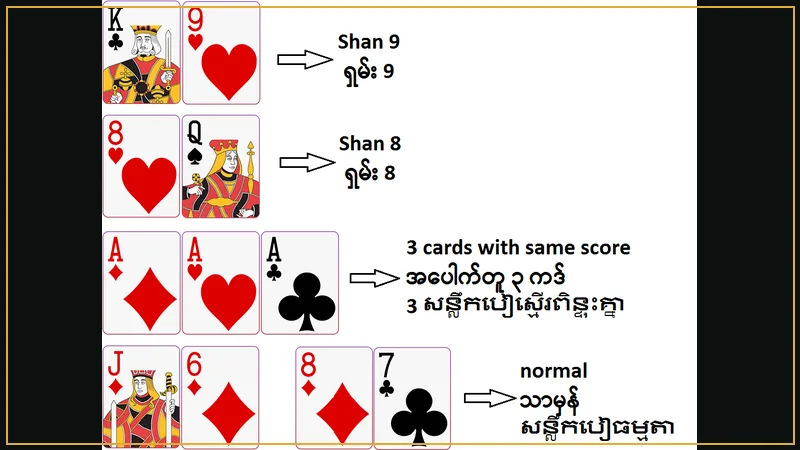
| Card Values | Ace = 1, 2-9 = Face Value, 10/J/Q/K = 0 Points |
|---|---|
| Two-Card Natural Hands | Koe (9 Points), Sheet (8 Points) |
| Third Card Drawing Rule | Compulsory draw if 2-card total is 4 points or below |
| Multipliers | Same Suit (2x), Three of a Kind (3x), Royal Flush (5x) |
Point Calculation and Scoring Fundamentals
Points are calculated by summing card values and taking the last digit (e.g. 7 + 8 = 15, which counts as 5 points). Holding an 8 or 9 on the initial deal is declared immediately as a 'Natural' win.
Special Multiplier Combinations
If your winning hand consists of cards sharing the identical suit, your payout doubles (2x). Holding three cards of the exact same rank (Three of a Kind / အပူးသုံးလုံး) multiplies payouts by 3x or 5x depending on table rules.
Related Guides & Feature Portals

Shan Koe Mee APK Download — Dedicated Mobile Card Game Client
Download the dedicated Shan Koe Mee APK for Android. Fast 11MB client, smooth multiplayer tables, private room...

Shan Koe Mee 777 — High Stakes & VIP Card Salons
Experience high-stakes Shan Koe Mee 777 on A80. Table limits up to 10,000,000 MMK, private salons, VIP dealer ...

Shan Koe Mee Online — Real Money Traditional Card Play
Play Shan Koe Mee online for real Myanmar Kyat. Instant matchmaking, thousands of active players, fair RNG dea...
Bu Gyi Card Game — Traditional Burmese Three-Card Play
Master Bu Gyi (ဘူကြီး) card game on A80 Myanmar. Learn three-card hand rankings, banker rotation, payout multi...

Myanmar Fish Shooting Arcade — Laser Cannons & Sea Bosses
Play Myanmar fish shooting arcade games on A80. Upgrade laser cannons, hunt golden dragons, and win up to 1000...
Shan Koe Mee Strategy — Bankroll Rules & Dealer Psychology
Master Shan Koe Mee with expert tips. Learn banker psychology, card counting basics, third-card draw rules, an...
Essential Inquiries & Guidance
Can you stand on 5 points in Shan Koe Mee?
Yes, players holding 5, 6, or 7 points have the option to stand or draw a third card to improve their score.
What beats an 8 (Sheet)?
A 9 (Koe) beats an 8. If points are tied, table rules dictate whether the hand pushes or goes to suit hierarchy.